
Book: Nature-Based Solutions for European Vineyards
Nature-Based Solutions for European Vineyards
Solutions for Transformative Change
Edited by Udaya Sekhar Nagothu
Enhancing and upscaling nature-based solutions – summary and recommendations
Udaya Sekhar Nagothu
DOI: 10.4324/9781003715108-16
This chapter has been made available under a CC BY-NC-ND 4.0 International license.
Introduction
The concept of nature-based solutions (NbS) is gaining popularity, with increasing support and interest among policy makers, public sector and civil society. This is because NbS is seen as a promising approach to address societal challenges, including climate change and extremities, conservation of biodiversity and ecosystem services. It has now been endorsed by relevant international agencies, and the European Union encourages countries to integrate NbS into their respective Nationally Determined Contributions, as well as agricultural programs. Yet, the concept is being debated, its impacts and scalability questioned, and there is a lack of adequate investments to support wider implementation to bring about a transformative change. Gerstetter et al. (2020) argue that NbS have the potential to contribute to achieving the UN sustainable development goals (SDGs) because they often address public interest objectives and sustainability dimensions. However, they emphasize that it can be achieved effectively only through the active and sustained collaboration of various actors in society and require an indicator-driven policy approach.
The EU defined NbS as Solutions that are inspired and supported by nature, which are cost-effective, simultaneously provide environmental, social and economic benefits and help build resilience. Such solutions bring more, and more diverse, nature and natural features and processes into cities, landscapes and seascapes, through locally adapted, resource-efficient and systemic interventions. (EU, 2022)
According to Kill (2024), the existing definitions of “nature-based solutions” are still vague and leave a lot of room for interpretation, and even co-optation, hiding the complex realities of stakeholder interests. It seems sometimes like a catch-all concept with a lack of clarity. The chapter authors in this book perceive that NbS is about working with nature and helping to build ecosystem resilience, which in turn improves the vines’ ability to tolerate better the climate and environmental impacts. It is about implementing NbS that have been partly lost over the years with agricultural intensification and are now being applied again to restore biodiversity and ecosystem services. The enhanced biodiversity in turn contributes to better expressions of terroir and aromatic profiles in wine.
The book chapters focused on the potential of NbS to combat climate risks, based on experiences from the work done in selected European vineyards. The chapters have been written by several authors with varied disciplinary and managerial backgrounds from different countries. Their contents are mostly based on real-time research and management experiences of the authors implementing NbS. Hence, it is the first-hand knowledge which will be valuable for readers, providing details about the applicability, standards, barriers and future potential of the NbS both at the individual vineyard and landscape level in some cases. This book was able to include selected cases of NbS implemented in the European vineyards to demonstrate how they can directly or indirectly help to improve soil health, biodiversity conservation, ecosystem services and wine quality.
The chapters have been organized broadly into four different sections, starting with Chapters 1 and 2 providing introduction and transdisciplinary framework, which sets the basis for other chapters in the book. These chapters discussed the basic principles of NbS and fundamental ideas about NbS in agriculture and the multi-taxon approach to assessing the impacts of NbS for improving biodiversity and ecosystem services in vineyard landscapes. Chapters 3–5 mostly focused on soil health and soil management and their role in ensuring healthy vines through NbS interventions supported by technology evidence. Chapters 6–8 shared results of the work that focused on the importance of vineyard landscape management to provide habitat for birds and beneficial insects, such as bees and butterflies, which in turn reduce risks from pests and diseases. Chapters 9–13 shared real-time experiences of selected vineyard managers (Italy, Spain, Chile, Switzerland, Portugal and France) and how they have developed and implemented innovative NbS management approaches, for example, regenerative viticulture that promotes NbS in vineyards. Chapters 14 and 15 discussed the certification aspects and policy relevance. This final chapter summarizes the main messages from the various chapters in the book.
This introduction is followed by a short summary of the contents of each chapter. The main messages from this book are then synthesized, highlighting some of the main outcomes of the NbS. In the later part of the chapter, the barriers to implementing and scaling up NbS and the possible measures to address them are identified. Towards the end, this chapter presents a brief policy overview in favour of NbS and then concludes with some recommendations and a way forward.
Chapter summaries
Chapter 1 broadly presented the concept of NbS, its brief history and how it was mainstreamed into the research and development agenda in recent years. This was followed by a discussion of major challenges of the current farming systems in general and vineyard landscapes in particular. The authors then provided a review of innovative approaches and pathways for a transition towards sustainable NbS, including biodynamic, organic and regenerative viticulture. This was followed by a transdisciplinary conceptual framework for NbS implementation, showing the importance of linkages between science, stakeholders and policy. In addition, the benefits of implementing NbS and the supporting policy frameworks were briefly discussed. Towards the end, a brief outline of this book was described in the chapter.
Chapter 2 reviewed the current research on biodiversity and ecosystem services in vineyards, considering soil microbiota, edaphic arthropods, vascular plants, honeybees and wild pollinators such as butterflies and wild bees as indicators. While most studies considered a single taxonomic group, this chapter synthesized experiences from the case studies that adopted a multi-taxon approach, considering the interaction between different taxonomic groups and comparing organic and conventional vineyards, and the need for such an approach. The chapter presented results that demonstrated how agroecology based on sustainable management practices positively influences biodiversity and the vineyard ecosystem in general. The chapter demonstrated that vineyards managed through biodiversity-friendly practices both at the field scale (e.g., maintaining permanent herbaceous cover in the inter-row or mowing an inter-row every two years, no-tillage or minimum tillage) and at the landscape scale (conserving natural and semi-natural habitat within the farm) can lead to win-win solutions that sustain both biodiversity (and hence conservation value and ecosystem services) and high-quality productions.
In Chapter 3, the authors explored the importance of soil microbiomes and their functions in maintaining soil health and vineyard sustainability and ensuring high-quality wine production. Drawing from their experience and relevant research, the chapter presented case studies conducted in the Chianti area (Tuscany, Italy) to illustrate key findings. The chapter focused on three aspects: (i) the role of soil microbiomes in redefining terroir, (ii) impacts of soil management and plant protection on soil microbiomes and (iii) the relationship between soil microbiomes, grapes and wine quality. The chapter concluded that integrating microbial insights into viticultural practices provided a promising path towards sustainable wine production, thus reinforcing the link between microbiome diversity, terroir expression and premium wine characteristics.
Mediterranean vineyard soils are often affected by erosion and organic matter depletion, threatening soil health, biodiversity and vine performance.
Chapter 4 presented a replicable interdisciplinary framework to assess soil restoration through organic soil conditioners over a minimum three-year period. The approach integrates GIS tools and proximal soil sensing to define homogeneous experimental areas and optimize field trial design, combined with replicated comparisons between treated and control vineyard rows. Soil restoration was evaluated using standardized physicochemical analyses, bacterial community assessments (culturable abundance, metabolic profiling and DNA metabarcoding), mesofauna biodiversity indicators based on microarthropods (QBS-ar) and vine ecophysiological measurements, including gas exchange, water-use efficiency and leaf functional traits. The methodology was applied to a Brunello di Montalcino vineyard (Tuscany, Italy) using a worm-composted cattle-manure-based soil conditioner. The treatment resulted in increased soil organic carbon and improved C/N ratio, alongside shifts in bacterial community structure and a marked enhancement of soil biological quality. Vines exhibited improved photosynthetic performance, higher water-use efficiency and increased leaf structural integrity, indicating enhanced resilience to water stress. Overall, the results demonstrate that organic soil conditioners, assessed through an integrated and cost-effective approach, can effectively restore soil health and support sustainable viticulture in Mediterranean environments.
Chapter 5 compared the use of herbicides and tillage versus the establishment and management of a permanent green cover vegetation and the impacts on the vineyard ecosystem. The authors discussed several advantages of green cover crops, including protection of the soil and its fertility, enhancement of soil microbial activity, reduction of nutrient and pesticide leaching, decreased reliance on herbicides, improvement of soil bearing capacity, providing a barrier effect against invasive weed species and promoting biodiversity. The chapter presented results from the trials, comparing different soil maintenance and cover strategies in the inter-row space carried out over three years with different autochthonous mixtures in the Chasselas terroir in the Lake Geneva basin (Switzerland). It further recommended mixture of selected plant species guided by a trait-function-service framework, implying that the plants included in the mixture should exhibit moderate vigour, to reduce mowing frequency, minimize crop interference and allow the expression of a diverse flora. The trait-based selection approach offers a transferable methodology to identify suitable species or ecotypes adapted to local pedoclimatic conditions and native flora, thereby enabling application across diverse viticultural settings. The participatory approach with bottom-up knowledge inputs is important to prioritize locally adapted species and ecotypes.
Chapter 6 focused on alien invasive pests that threaten to disrupt ongoing efforts to adopt more environmentally friendly pest management practices in the viticultural sector. In Europe and, more specifically for this chapter, in southern Switzerland, the last decade has seen an increase in the frequency of introductions of harmful insect species. In this chapter, the authors discussed experiences gained with the Flavescence dorée pathosystem, the spotted wing drosophila, Drosophila suzukii, and more recently introduced species such as the leafhopper Erasmoneura vulnerata and the leafminer Aspilanta oinophylla. The authors argue that use of insecticides may be necessary in the early stages of invasion, but alternative solutions such as NbS are needed in the medium term to respond to the compounded impacts of invasive pests, climate change and increasingly stringent regulation on plant protection products. Using results from case studies, the chapter demonstrated that a better understanding of the characteristics of the environment and landscape structure is necessary to enhance natural pest regulation and management mechanisms. Against this backdrop, the authors discussed the prospects of a systems approach based on habitat management strategies to ensure vineyard productivity while meeting public and market demands for sustainable viticultural practices.
Chapter 7 highlighted the crucial role of microbial biodiversity in vineyards and how it influenced grape quality and spontaneous wine fermentation. Yeasts associated with vines and grapes include a wide range of species belonging to the Saccharomyces and non-Saccharomyces genera, which contribute both to plant protection against pathogens and to the definition of the wine’s aromatic profile. The chapter reviewed recent studies that demonstrated the role of social insects, such as honeybees (Apis mellifera), as vectors of oenologically relevant yeasts, particularly Saccharomyces cerevisiae, which can be transferred between bees and grapes. Thus, the presence of apiaries in vineyards appears to significantly increase yeast counts in grape must, suggesting an active microbial dispersion mechanism and yeast population selection driven by pollinating insects. The authors recommended integrating apiaries into vineyards to enhance vineyard microbiome stability and positively influence wine quality within a sustainable viticulture framework.
Chapter 8 explored the ecological potential of vineyards and exemplified practical recommendations for biodiversity-friendly management based on the requirements of two flagship species, the Woodlark (Lullula arborea) and the Iolas Blue (Iolana iolas). Drawing on case studies from the winegrowing region of Valais in Switzerland, the chapter further illustrated how participatory multi-actor schemes, supported and advised by a local NGO, can facilitate coordinated conservation efforts across vineyard landscapes, for example, as habitats for specialized and endangered species in Europe. Agri-environmental schemes (AES) represent a key policy instrument to achieve such goals. These schemes come in three main forms – action-oriented, result-based, and multi-actor programs – which can be combined to enhance habitat quality and landscape heterogeneity. The chapter discussed the AES limitations and a range of complementary measures to overcome them. By aligning policy frameworks, market incentives and landscape-level planning, it is possible to create synergies that support both wine production and ecological resilience.
Chapter 9 demonstrated the potential of biodynamic farming as a holistic and nature-based approach to farming, seeking to restore soil vitality, biodiversity and ecological balance through closed-cycle management and the integration of plants, animals and humans within a single farm organism. The chapter outlined the theoretical and systemic foundations of biodynamic agriculture, emphasizing its holistic conception of the farm as a self-sustaining organism and the specific role of dynamized preparations (such as horn manure and horn silica) in stimulating soil fertility and plant resilience. The discussion situates biodynamics at the intersection between traditional knowledge and contemporary agronomic science, highlighting its contribution to regenerative viticulture and sustainable landscape management. Particular attention is given in the chapter to the role of biodiversity-focused NbS within biodynamic vineyards, including cover crops, ecological infrastructures and animal integration, which collectively enhance soil structure, water retention and ecosystem stability. The chapter presented experiences from the Rivetto Farm in Piedmont (Italy) as a representative case study illustrating the transition from conventional to organic and subsequently to biodynamic viticulture.
Chapter 10 shared experiences of Familia Torres who has been producing wines for over 150 years and is currently managing approximately 1,100 ha of vineyards in Spain, around 50% of which is under regenerative farming, and approximately 300 ha of vineyards in Chile, all of which are organic certified. Regenerative viticulture has significantly resulted in reduced tillage, increased use of cover crops and organic matter (biomass from cover crops and compost) and introduction of animals on the vineyards. The chapter presented results from three projects related to regenerative viticulture that confirmed progressive changes in soil regeneration, including reduction in erosion, improvement in soil structure, greater water retention capacity, increase in organic carbon sequestration and higher biological activity with a greater abundance of microorganisms (bacteria, fungi, protozoa, archaea) that help decompose organic matter and nourish the vineyard. The chapter showed that positive results due to the adoption of regenerative practices can help in a transformative change in all the vineyards of Familia Torres in the coming years.
Chapter 11 showcased the regenerative viticulture practices implemented on the Quinta de Covela vineyard estate, a pioneer of organic farming in Portugal since 2017, located in the Vinho Verde wine region. The estate commitment has been solidified by its certification from the Regenerative Viticulture Alliance in 2023. Regenerative nature-based practices were systematically implemented to improve vineyard ecosystem health. The chapter further demonstrated how plant health is managed through low-impact phytosanitary approaches involving botanical and mineral-based inputs and mate disruption techniques replacing conventional synthetic pesticides. Additionally, the benefits with the use of organic bioprotectants and biostimulants on the estate that contribute to photosynthetic efficiency, improvement in plant-microbiome interactions and better resistance to biotic and abiotic stressors were discussed in the chapter. The integration of these practices clearly illustrates the potential for regenerative approaches to reconcile high-value viticulture with ecosystem restoration and climate resilience.
Chapter 12 presented a very brief overview of the status of NbS and geographical spread of various approaches, including regenerative, organic and biodynamic farming in vineyards in France. The authors further discussed the impacts generated by practicing selected NbS on the vineyard ecosystem systems, the main challenges in producing organic, biodynamic or regenerative wines in France, and the technology and policy implications in the context of vineyards in France. Three case studies practicing NbS have been presented in the second part of the chapter to illustrate the contribution to biodiversity conservation and ecosystem services. Despite the constraints, there is much to learn from the experiences and knowledge developed in the vineyards in France practicing NbS.
Chapter 13 demonstrated how participatory approaches and transdisciplinary knowledge exchange in Biodistretto del Chianti led to integrating traditional and innovative NbS to enhance soil biodiversity, vineyard climate resilience and ecosystem functionality. By combining historical agricultural practices with modern ecological strategies, local farmers, researchers and stakeholders collaborated to develop sustainable viticulture models. In addition, the chapter discussed key NbS practices and the outcomes implemented in the Biodistretto del Chianti. The Biodistretto model of sustainable viticulture can be replicated in other winegrowing regions. The Pacina Case Study adopting the Biodistretto model was presented in the chapter. A new agroforestry perspective in vineyards, called vitiforestry, was introduced from the experiences in the region.
Chapter 14 provided a comprehensive overview of a first governmental application of NbS, the guidelines adopted by the Region Piemonte, Italy, famous for the hilly wine landscape of Langhe and Monferrato designated as UNESCO World Heritage Site. The guidelines contain 12 agroecology-based sustainable management practices, and the chapter discussed their positive impacts on vineyard ecosystem. These new vineyard models were introduced in the vineyards integrated within the Nature 2000 protected areas, the European network for biodiversity conservation. The Ecologic Incidence Assessment process of authorization of new vineyards is the regulatory framework for their application. The chapter presented experiences from practical application of the NbS in the Monte Fenera Regional Park, which covers the entire terroir of Boca wine, an ageing classical Nebbiolo of Piemonte. Public initiatives and participatory approach have promoted collaboration between the Park and local producers, increasing the implementation of NbS in the Park and promoting general awareness about the value of conserving biodiversity.
Chapter 15 focused on the motivation and technical foundations behind the Regenerative Viticulture Alliance (RVA) certification process in Europe, a pioneering international standard specifically designed for regenerative viticulture. The initiative was to cater to the need for establishing a regulatory framework for an agricultural model that not only mitigates the environmental impacts of winemaking activities but also actively promotes the regeneration of the vineyards’ soils from a holistic approach, creating a well-balanced ecosystem. The chapter detailed the development process of the standard, led by the verification entity ECOCERT and the specialized regenerative agriculture consultancy ‘The Regen Academy’. The chapter provides details of the two standards that make up the certification, namely (i) the Vineyard Standard and (ii) the Winery Standard. The corresponding certifications – RVA TRANSITION and RVA CERTIFIED – are discussed. Finally, this chapter serves as a practical guide for wine industry professionals interested in adopting regenerative practices, offering a clear and structured vision of the benefits and requirements associated with the RVA certification.
NbS to address key societal challenges in vineyard socio-ecosystems
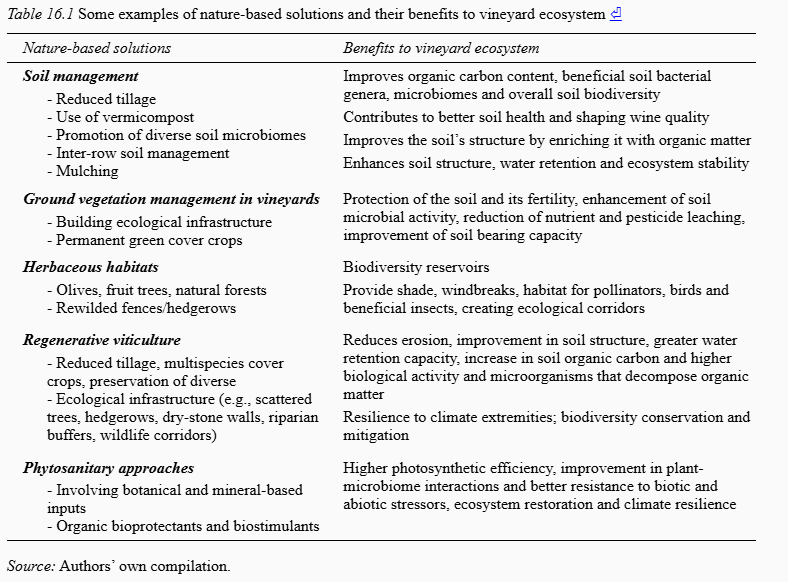
It is important to note that the authors contributing to the book chapters have first-hand experience working in vineyards as managers, researchers or experts in different countries over several years. The recommendations and observations presented in different chapters serve as practical guides to specific NbS. Chapter 14 has also shown how they can be applied in the vineyards policy. Several of the chapters (Chapters 2 and 10–13) in the book have clearly demonstrated that agroecology-based NbS practices can positively influence biodiversity and the vineyard ecosystem in general. An important aspect of vineyard ecosystem is to maintain good soil health that is critical to vineyard performance and resilience. There are several NbS that directly influence several parameters of soil health (Table 16.1), including soil structure and water holding capacity, and soil biodiversity and fertility (Chapters 3 and 4). The link between soil microbiome diversity, terroir expression and premium wine characteristics is highlighted in the chapters. The importance of conserving microbiome diversity on vineyard resilience cannot be undermined. Similarly, specific soil applications such as vermicompost-based digestates and inter-row soil management without inversion of soil layers can significantly contribute to increased productivity due to the increase in soil organic carbon content and higher relative abundance of certain bacterial genera (e.g., Methylotenera and Streptomyces) that are useful for promoting soil health.
